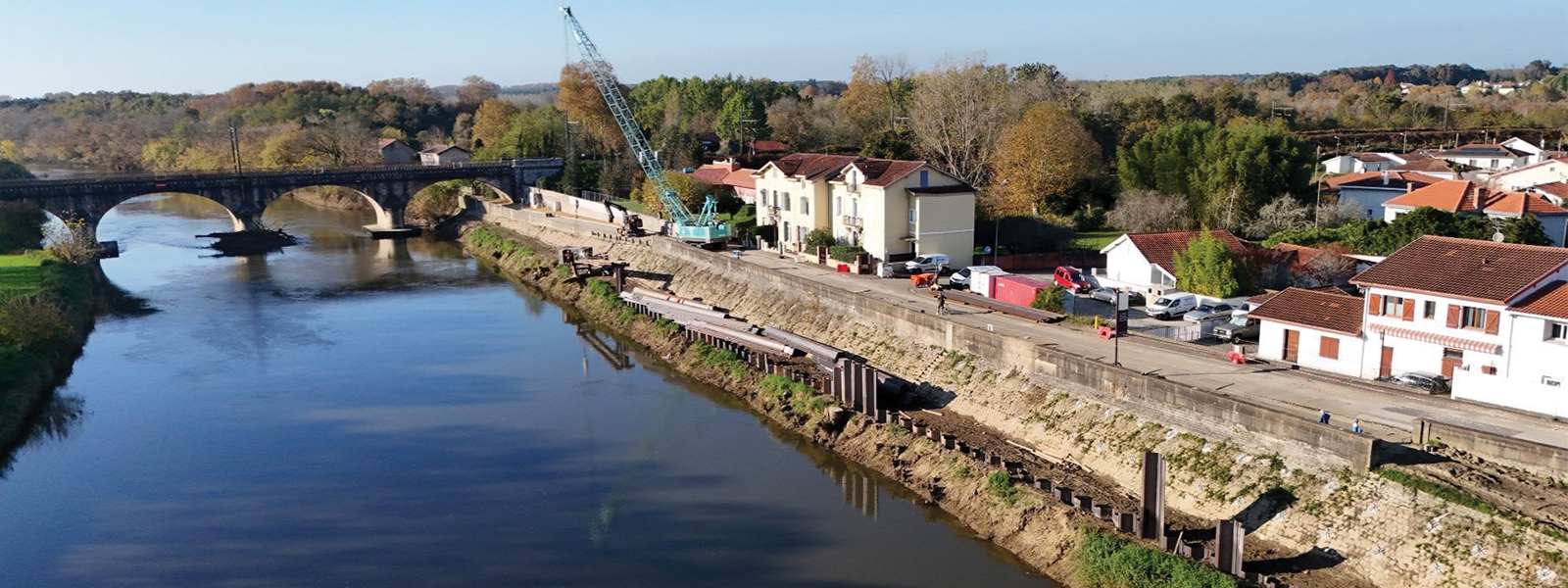
Reinforcement of river embankments – A comparative study in France – Flyer
Multi-criteria analysis

- Download center
- Reinforcement of river embankments – A comparative study in France – Flyer

AskBoris
How can we reinforce ageing river embankments to cope with the increased risk of flooding, whilst reducing costs, the carbon footprint and construction times?
River embankments play a vital role in protecting land from flooding, but many of them were designed for water levels that have now been exceeded. As a result of climate change, floods are becoming more frequent and more intense, highlighting the vulnerabilities of earth-filled embankments, particularly with regard to internal erosion and stability. Against this backdrop, this study forms part of an approach to sustainable management of hydraulic structures, offering an in-depth comparative analysis of reinforcement solutions tailored to current challenges.
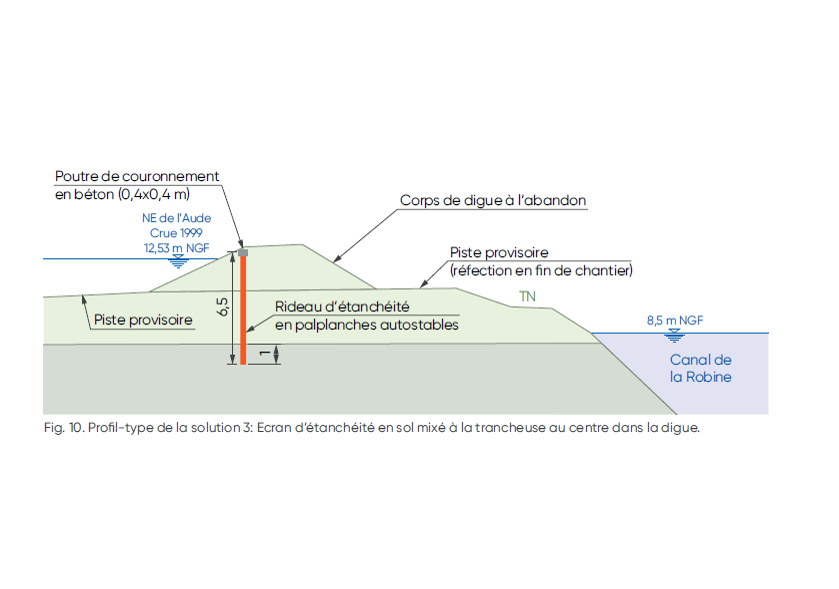
The study, led by Egis, compares three reinforcement techniques applied to a specific case: the Robine Canal in the Aude department. The solutions analysed are the relocation of the earth-filled embankment, reinforcement using cut-and-fill soil, and a self-supporting sheet pile wall.
Two scenarios are considered:
- a reference flood corresponding to the 1999 event;
- and a scenario incorporating a 50 cm raising to anticipate the effects of climate change.
Each solution is assessed according to technical, economic, environmental and social criteria, through a multi-criteria analysis.
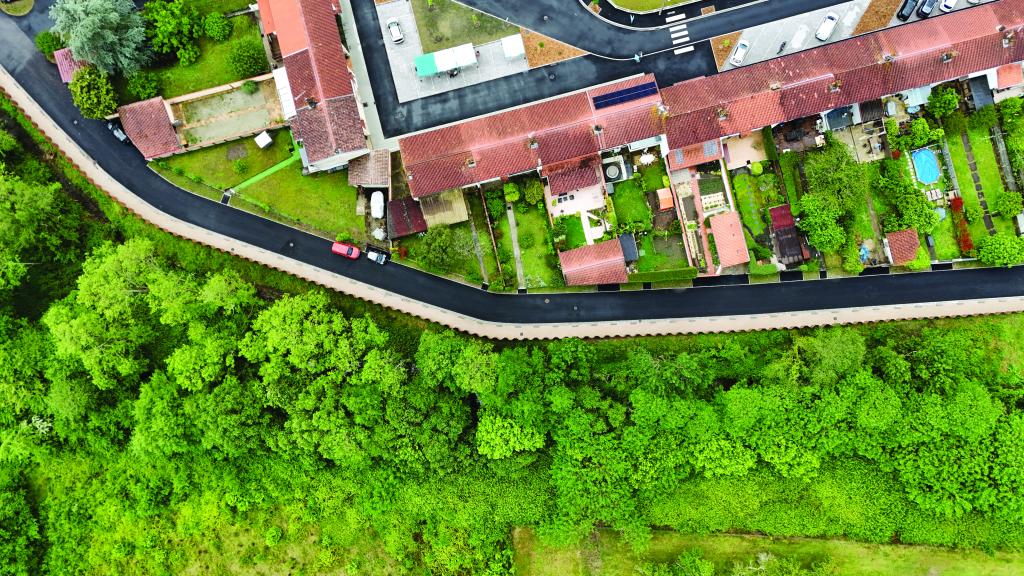
The results highlight the key advantages of the self-supporting sheet pile wall solution.
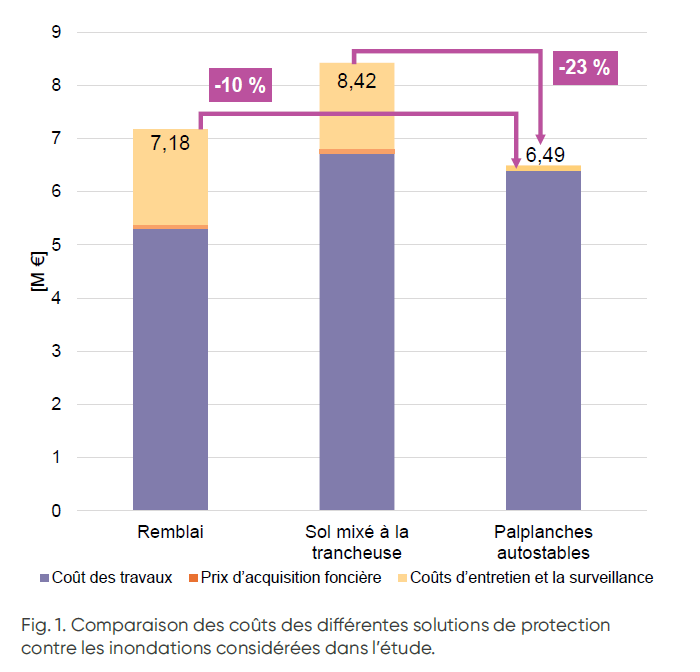
It is characterised by a significant reduction in overall costs of more than 20 per cent, construction timeframes that are substantially shortened by up to 50 per cent, and minimal land take. This solution also offers high technical performance, ensuring both the watertightness and stability of the structure, regardless of the condition of the existing embankment. Its integration into the landscape and social acceptance are facilitated by the retention of the existing embankment, which is left as a non-structural fill.
From an environmental perspective, the self-supporting sheet pile wall has the lowest carbon footprint of the solutions studied, both during the construction phase and during the operation and maintenance phases over a 100-year period, resulting in a total carbon footprint over the life cycle that is reduced by nearly 50 per cent. By combining sustainability, technical efficiency, speed of implementation and low environmental impact, this solution appears to be the most suitable for meeting current and future flood protection challenges, whilst forming part of a responsible approach to river infrastructure management.
Download
 French



Related document
For further details, please also see the full brochure